7 Days of Razor Clam Digging Approved

In a Press Release found here, Washington Department of Fish and Wildlife (WDFW) shellfish managers have approved 7 days of razor clam digging beginning Thursday, January 15. 

We have launched a new gear shop. Check out all the new colors and styles HERE.

Approved Dig Dates, Tide Times, and Beach Locations Appear Below.

Confirmed dates during evening tides (noon to midnight only):

  • Jan. 15, Thursday, 4:35 p.m.; 0.4 feet; Long Beach, Twin Harbors, Mocrocks
  • Jan. 16, Friday, 5:14 p.m.; 0.0 feet; Long Beach, Twin Harbors, Copalis
  • Jan. 17, Saturday, 5:50 p.m.; -0.3 feet; Long Beach, Twin Harbors, Copalis
  • Jan. 18, Sunday, 6:24 p.m.; -0.5 feet; Long Beach, Twin Harbors, Mocrocks
  • Jan. 19, Monday, 6:57 p.m.; -0.5 feet; Long Beach, Twin Harbors, Mocrocks
  • Jan. 20, Tuesday, 7:29 p.m.; -0.4 feet; Long Beach, Twin Harbors, Copalis
  • Jan. 21, Wednesday, 8:01 p.m.; -0.1 feet; Long Beach, Twin Harbors, Copalis

Make sure you are on an approved and OPEN beach before you start digging. 

Be sure to check out the Razor Clam Society Beach Map to know where and when to dig.

2025-2026 recreational hunting and fishing licenses are required as of April 1, 2025

The DAILY LIMIT per person is 15 clams, no matter what condition they are in, once removed from the sand, the clams must be kept. Digging is prohibited in the razor clam reserve located just south of the Ocean City approach on Copalis, which are marked by 10-foot poles with signs. Always check with official sources if you have any questions. All diggers age 15 or older must have an applicable fishing license to harvest razor clams on any beach. And, each digger must keep their razor clams in a separate container. Don’t mix your clams. Licenses, ranging from a three-day razor clam license to an annual combination fishing license, are available from license vendors around the state and WDFW’s licensing customer service number at (360) 902-2464————————————————

Razor Clam Society

120 State Avenue NE, Suite 1014Olympia, WA 98501-8212

www.razorclamsociety.org

Twitter: @razorclamsocy

Instagram: @razorclamsocietyFaceBook: facebook.com/razorclamsociety
Donate: PayPal.Me/RazorClamSociety

a 501(c)(3) charitable organization
The Acid Test

Washington Department of Fish & Wildlife (WDFW) has just released domoic acid test results for razor clam beaches. Trends are looking favorable for razor clam enthusiasts.

The test results appear below.

In a communication to recipients of the test results, Dan Ayers, Coastal Shellfish Manager for WDFW, noted: “We were hoping that today’s razor clam domoic acid results would allow us to open Mocrocks. However, as you can see below, no future razor clam dates will be announced until domoic acid levels in razor clams drop below the action level in two sets of consecutive tests, at least 7 days apart. We will be collecting samples every seven days (as low tides allow) with the hope that some beach may be able to open soon.”

Note that in all these samples; only razor clam meat tissue is tested.

Long Beach Area E (north): Collected 4/15/21

·                     domoic acid =   26 ppm

·                     PSP = none detected

·                     DSP = none detected

Twin Harbors Area CL (middle): Collected 4/15/21

·                     domoic acid =   11 ppm

·                     PSP = none detected

·                     DSP = none detected

Copalis Area XK (middle): Collected 4/13/21

·                     domoic acid =   26 ppm

·                     PSP = none detected

·                     DSP = none detected

Copalis Area XL (middle): Collected 4/13/21

·                     domoic acid =   30 ppm

·                     PSP = none detected

·                     DSP = none detected

Copalis Area GS (north): Collected 4/13/21

·                     domoic acid =   20 ppm

·                     PSP = none detected

·                     DSP = none detected

Mocrocks Area BC (south): Collected 4/18/21

·                     domoic acid =   1 ppm

·                     PSP = none detected

·                     DSP = none detected

Mocrocks Area CP (middle): Collected 4/18/21

·                     domoic acid =   27 ppm

·                     PSP = none detected

·                     DSP = none detected

Mocrocks Area MP (north): Collected 4/18/21

·                     domoic acid =   20 ppm

·                     PSP = none detected

·                     DSP = none detected

Call A Sturgeon

Editors Note: Washington State Department of Fish & Wildlife (WDFW) are really an amazing group of folks, and this press release clearly demonstrates why. Of particular interest is the fact that the White Sturgeon in Lake Roosevelt is in great abundance as a direct result of programs initiated by WDFW.

WDFW FISHING RULE CHANGE  
Washington Department of Fish and Wildlife
1111 Washington St. SE, Olympia, WA 98501
https://wdfw.wa.gov/

May 19, 2020

Lake Roosevelt white sturgeon fishery

Action: Opens a harvest fishery for white sturgeon in Lake Roosevelt.

Effective date: Open 7 days per week beginning June 15, 2020 until further notice.

Species affected: White Sturgeon

Location: From Grand Coulee Dam to China Bend Boat Ramp (including the Spokane River from Highway 25 Bridge upstream to 400′ below Little Falls Dam, Colville River upstream to Meyers Falls Dam and the Kettle River upstream to Barstow Bridge)

Fishery Rules: Daily limit 1 sturgeon. Annual limit 2 sturgeon. It is legal to retain sturgeon between 50 inches and 63 inches fork length. Fork length is measured from the tip of the snout to middle of the fork in the caudal fin (tail). All harvested sturgeon must be recorded on a Catch Record Card (Catch Code 549). Two-pole fishing is allowed. Closed to night fishing. Anglers may continue to catch and release after obtaining a daily limit but must cease fishing after the annual limit has been taken. All other statewide rules for white sturgeon must be observed.

Anglers are asked to use heavy gear (50-lb. test mainline and leader at a minimum) and use 14/0 hooks or smaller to avoid catching and/or injuring large wild adult sturgeon. The request to use heavier gear will ensure anglers hook and land sturgeon effectively, but also is protective of large wild adult sturgeon that, if hooked, should be played to hand quickly and released without being removed from the water. WDFW recommends that any fish that will not be legally retained should not be removed from the water prior to release.

Reason for action: White Sturgeon hatchery programs began in 2001 in British Columbia (BC) and 2004 in Washington. Stocking ranged from 2,000-12,000 juvenile sturgeon per year from 2001 to 2010 (including both Washington and BC releases). Survival of hatchery-produced juvenile sturgeon was much higher than anticipated. As a result, there is a surplus of hatchery-origin sturgeon available for harvest from Lake Roosevelt.

Additional information: The Lake Roosevelt co-managers (WDFW, Spokane Tribe of Indians and the Confederated Tribes of the Colville Reservation) will all be conducting sturgeon fisheries. Non-tribal anglers are asked to be respectful of tribal angling, and both tribal and non-tribal sturgeon research that is occurring on the reservoir.

Anglers are reminded that fishery dates, times, slot limits, daily limits and annual limits may be adjusted over time to ensure that a sustainable population of sturgeon is maintained in Lake Roosevelt, as well as equitable access to the fishery amongst the three co-managers.

Information contact: For more information, contact Chris Donley, WDFW Region 1 Fish Program Manager (509) 892 1001 ext. 307 or Bill Baker, WDFW District 1 Fisheries Biologist (509) 563-5499.

In Case You Missed It….

A press release from WDFW.

Published on Apr 27, 2020

OLYMPIA –The Washington Department of Fish and Wildlife (WDFW) and Washington State Parks and Recreation Commission (Parks) announced today they will reopen state-managed lands on Tuesday, May 5, for local day-use only recreation.

The reopening will apply to state-managed parks, wildlife areas, recreation land, and boat launches. However, it may take several days for gates to be unlocked and sites to be serviced at remote areas due to limited staff capacity.

Some parks may not open immediately due to impacts on rural communities and the potential for crowding. State Parks is working with local communities and its partners to determine the best approach and timing to reopening these areas.

Visitor centers, camping, and other overnight accommodations on state-managed lands will remain closed until further notice.

The Department of Natural Resources (DNR) also plans to reopen their recreation lands on May 5 for day-use. [Note: as of May 13, camping remains closed. Check the link for specific regional openings & closures.]

State land managers recommend people come prepared and bring their own hand washing supplies, toilet paper, and personal protective equipment as some sites will have reduced or limited restroom facilities. People should also be prepared to change plans if their destination appears crowded or is not yet fully operational.  

If sites become overcrowded or other COVID-19 related public safety concerns develop, state agencies may close areas with limited notice to further protect public health and safety. Certain restrictions around specific activities may also apply. 

The public can find the latest information about WDFW and Parks operations at:


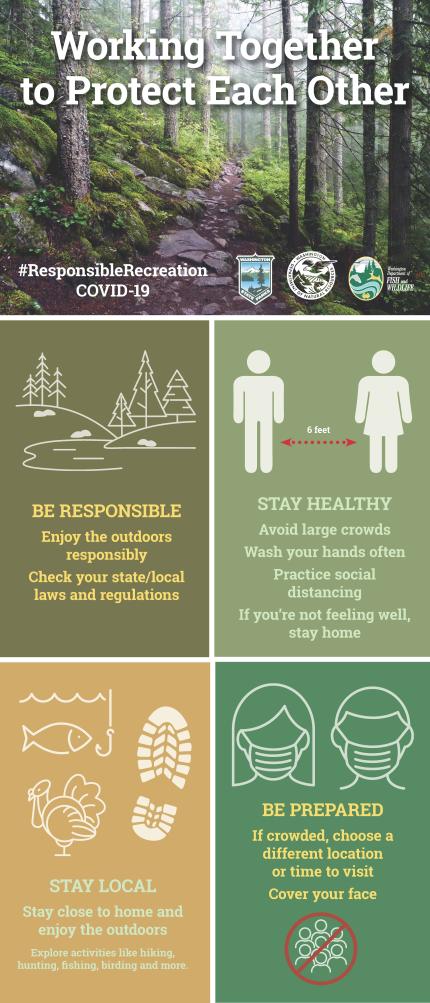
Guidelines to recreate responsibly during COVID-19 public health crisis

Before you go 

  • Check what’s open. While many state-managed land destinations are open for day-use, other local, tribal, and federal land may still be closed. 
  • Opt for day trips close to home. Overnight stays are not permitted.
  • Stay with immediate household members only. Recreation with those outside of your household creates new avenues for virus transmission.
  • Come prepared. Visitors may find reduced or limited restroom services as staff begin the process to reopen facilities at wildlife areas and water access sites.  You are advised to bring your own soap, water, hand sanitizer, and toilet paper, as well as a mask or bandana to cover your nose and mouth.
  • Enjoy the outdoors when healthy. If you have symptoms of fever, coughing, or shortness of breath, save your outdoor adventure for another day.  

When you get there 

  • Avoid crowds. Be prepared to go somewhere else or come back another time if your destination looks crowded. 
  • Practice physical distancing. Keep six feet between you and those outside your immediate household. Launch one boat at a time to give others enough space to launch safely. Leave at least one parking space between your vehicle and the vehicle next to you. Trailer your boat in the same way. 
  • Wash your hands often. Keep up on personal hygiene and bring your own water, soap, and hand sanitizer with you.  
  • Pack out what you pack in. Take any garbage with you, including disposable gloves and masks.